Why Version Control Exists: The Pendrive Problem
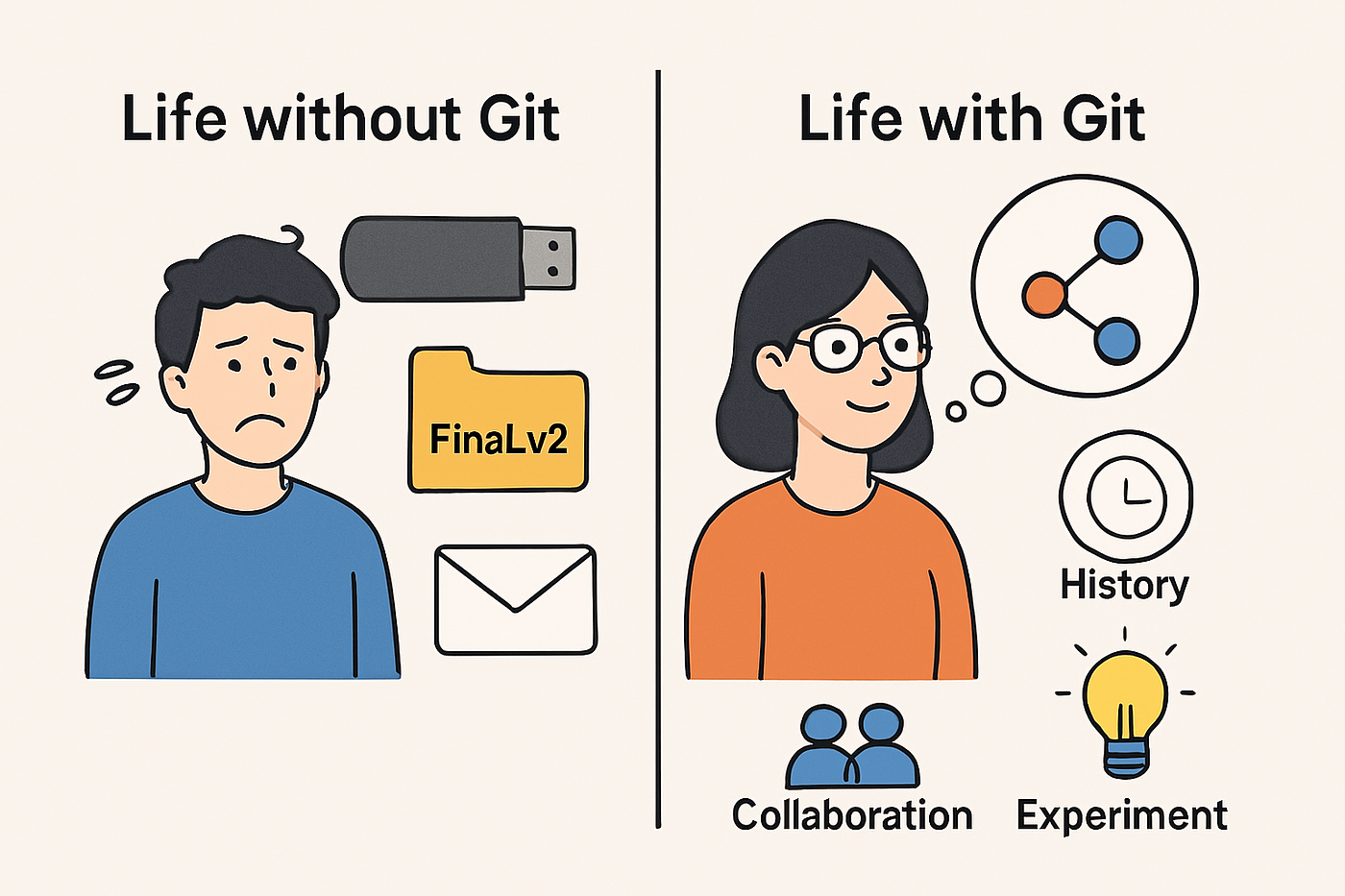
Once upon a time, software teams trusted pendrives.
One pendrive. One “latest version.” Files were overwritten, lost, or copied endlessly
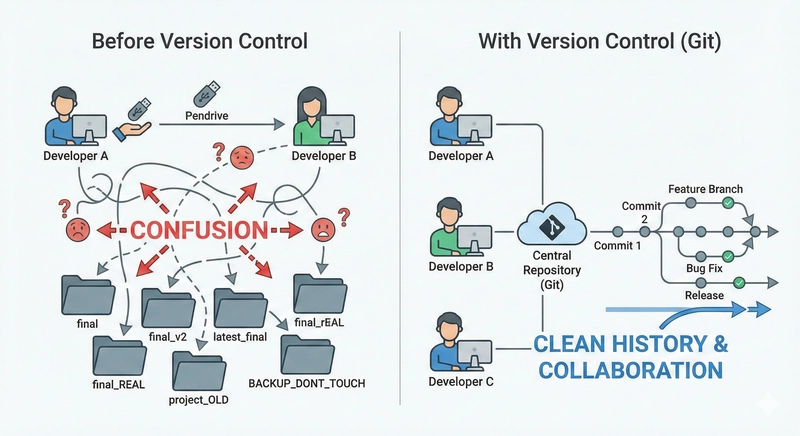
Before Version Control
A project starts small. One folder. One file. Everything is fine.
Then changes begin.
Suddenly the folder looks like this:
project_final
project_final_v2
project_final_latest
project_final_latest_fixed
And no one remembers which one is running.

The Pendrive Era
Before version control systems were common, teams shared code using:
Pendrives
Email attachments
Shared folders
A typical workflow looked like this:
One developer copies the project to a pendrive
Makes changes
Hands it to the next person
Someone forgets to copy the latest version
Work gets overwritten
No history. No traceability. No way back.
If the pendrive was lost or corrupted, the work was simply gone.
it failed not because pendrives are bad but because software development should be trackable and collaborative.

Real Problems Teams Faced
Teams struggled with very real, very human problems:
Overwritten code - someone saved over someone else’s work
Lost changes - no backup, no history, no recovery
No accountability -who changed this, when, and why?
No collaboration visibility - no idea what others were working on
But there was an even deeper problem.
There was nothing tracking the project itself.
No clear record of:
What changed
What was added
What was deleted
Every version was just another copy. Once a file was replaced, the past was gone.
They needed a system that could remember changes instead of replacing files.
That chaos is exactly what Linus Torvalds ran into while building the Linux kernel.
Hundreds of contributors. Changes coming in from everywhere. No safe way to track what changed, what broke, or how to go back.
So he did what engineers do when the system fails.
He built a better one.
That system became Git a version control system designed to track every change.

The Big Idea That Changed Everything
Git didn’t introduce magic.
It introduced one powerful idea:
Don’t track files. Track changes.
Instead of copying entire projects:
Record what changed
Store when it changed
Store who changed it
Allow safe rollback
Every change becomes a first-class citizen.
The project gains memory.
Why Version Control Exists
Version control exists because software needs to be:
Trackable
Collaborative
Recoverable
It solves problems that humans cannot solve reliably at scale.
With version control, teams can:
Work in parallel without overwriting each other
Experiment safely
Undo mistakes without fear
Understand the history of a project
Without it, modern software development simply doesn’t work.
Pendrive Workflow vs Version Control Workflow
Pendrive Workflow
One “latest” version
Manual copying
Silent overwrites
No history
No recovery
Version Control Workflow
Every change recorded
Parallel work
Full history
Safe rollback
Clear ownership
One replaces hope with guarantees.
Why Version Control Is Mandatory Today
Today, version control is not optional.
Every modern system assumes:
Multiple developers
Continuous changes
Frequent deployments
Long-lived codebases
Without version control:
Debugging becomes guesswork
Collaboration breaks down
Scaling teams becomes impossible
With version control:
History becomes a feature
Mistakes are reversible
Teams move faster, not slower

Conclusion
Pendrives didn’t fail because they were bad tools.
They failed because software development outgrew them.
Software needs memory.
Teams need visibility.
Change needs to be tracked, not replaced.
Version control wasn’t invented for convenience.
It was invented for survival.
And that’s why every modern developer frontend, backend, or DevOps starts their journey with Git.


