TCP: Reliable Communication on the Internet
Why Data Needs Rules Before Being Sent
Imagine sending important documents across a city without:
Knowing if the receiver is ready
Knowing if anything gets lost
Knowing if pages arrive in order
That’s exactly what would happen on the internet without rules.
Networks are unpredictable:
Packets can be dropped
Paths can change
Receivers can be slower than senders
This is why TCP exists.

What Is TCP and Why It Is Needed
TCP (Transmission Control Protocol) is a transport-layer protocol designed to provide reliable communication between applications.
Its job is to make sure that:
Data reaches the correct destination
Data arrives in the correct order
Missing data is retransmitted
Communication happens smoothly between sender and receiver
TCP is used whenever correctness matters more than speed.
Problems TCP Is Designed to Solve
TCP exists to solve these core problems:
No guarantee of delivery → TCP adds acknowledgements
Out-of-order packets → TCP uses sequencing
Packet loss → TCP retransmits
Overwhelming the receiver → TCP uses flow control
Network congestion → TCP slows down intelligently
Without TCP, applications would need to solve all of this themselves.

TCP Is Connection-Oriented
Before sending data, TCP establishes a connection between the sender and receiver.
This connection:
Reserves resources (buffers, bandwidth)
Synchronizes both sides
Confirms both are ready to communicate
Think of it like a phone call:
- You don’t start talking until the other person says “hello”
What Is the TCP 3-Way Handshake?
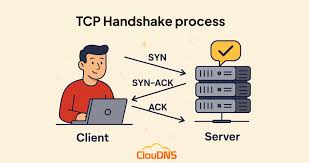
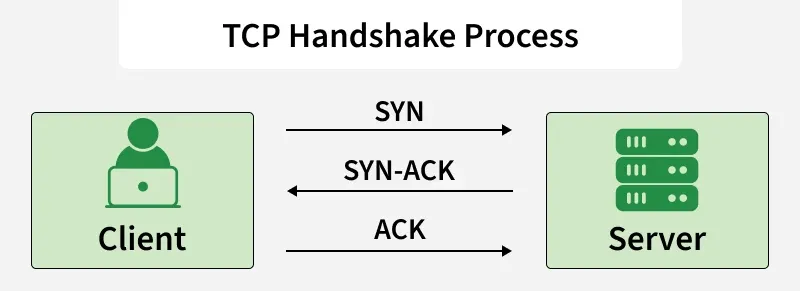
The 3-way handshake is how TCP establishes a connection.
It ensures:
Both sides are alive
Both sides agree to communicate
Initial sequence numbers are synchronized
It consists of three steps:
SYN
SYN-ACK
ACK
Step-by-Step: SYN, SYN-ACK, ACK
Step 1: SYN (Client → Server)
The client says:
“I want to talk, and here’s my starting point.”
Client sends a SYN packet
Includes an initial sequence number
Tells the server it wants to establish a connection
Analogy:
Dialing a phone number.
Step 2: SYN-ACK (Server → Client)
The server replies:
“I hear you, and I’m ready too.”
Server acknowledges the client’s SYN
Sends its own SYN
Shares its own sequence number
Analogy:
The other person picks up and says “Hello”.
Step 3: ACK (Client → Server)
The client responds:
“Got it. Let’s start talking.”
Client acknowledges the server’s SYN
Connection is now established
Analogy:
You reply “Hello” back.
At this point, both sides are synchronized.
How Data Transfer Works in TCP
Once the connection is established:
Data is sent as a byte stream
Each byte is numbered using sequence numbers
Receiver sends acknowledgements for received data
TCP doesn’t send data blindly—it waits for confirmation.
How TCP Ensures Reliability, Order, and Correctness
TCP achieves this using:
Sequence Numbers
Every byte has a number
Receiver knows the correct order
Missing bytes are detected easily
Acknowledgements (ACKs)
Receiver confirms what it received
Sender knows what was successful
Retransmission
- If data is missing, TCP resends it
Flow Control
Receiver advertises how much data it can handle
Sender slows down if needed
Together, these guarantee:
No data loss
Correct ordering
Stable communication
How a TCP Connection Is Closed
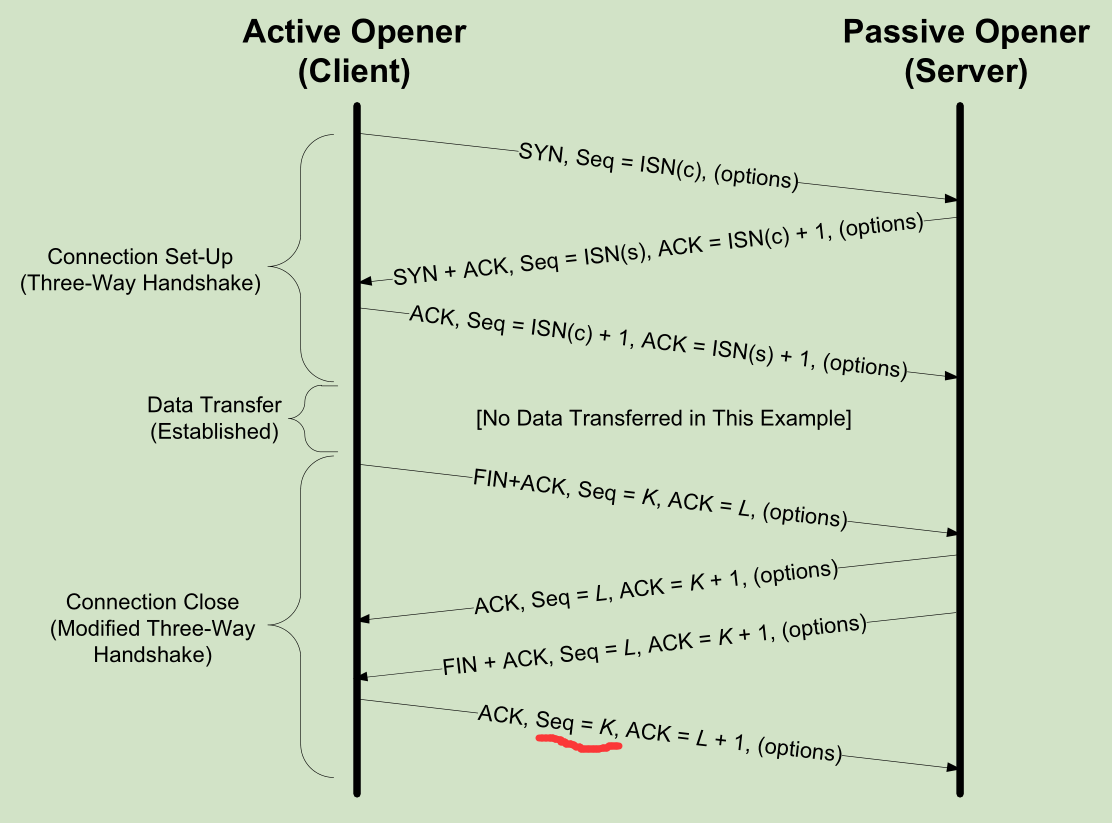
TCP closes connections gracefully, not abruptly.
This is done using FIN and ACK messages.
Simple View:
One side says: “I’m done sending” (FIN)
Other side acknowledges (ACK)
Other side sends its own FIN
Final ACK confirms closure
This ensures:
All remaining data is delivered
No data is cut off mid-transfer
Why TCP Is So Widely Used
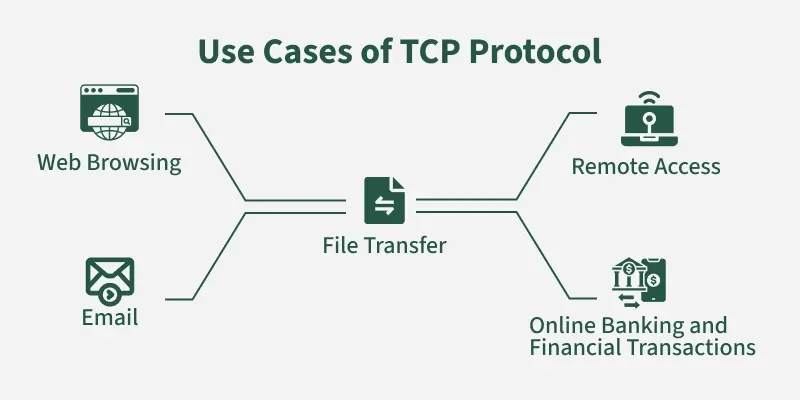
TCP is used by:
HTTP / HTTPS
APIs
File transfers
Emails
Databases
Anywhere data must be correct, TCP is the default choice.
Final Takeaway
TCP turns an unreliable network into a reliable communication channel.
By:
Establishing connections
Tracking data
Handling loss
Closing cleanly
It allows applications to focus on logic instead of networking problems.


